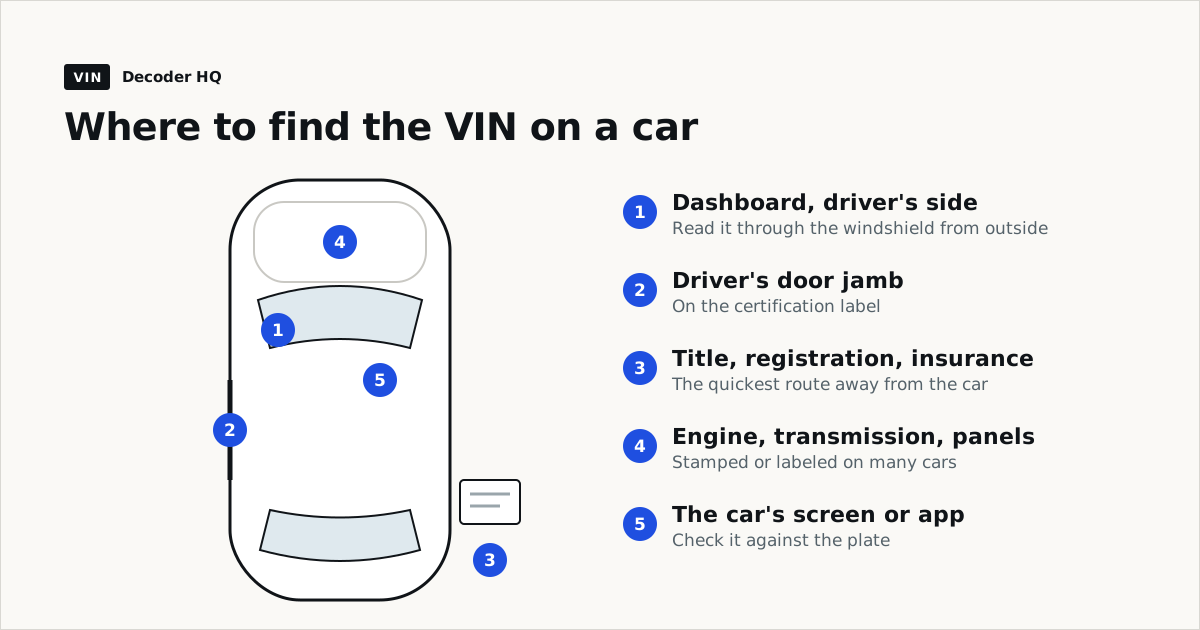
Where is the VIN number on a car? Look on the dashboard at the driver's side, right where it meets the windshield. Stand outside the car, look down through the glass near the left windshield pillar, and you will see a small plate with 17 characters. That spot is set by federal rules, so it is the same on almost every car, SUV and pickup sold in the US.
If the plate is dirty, cracked or covered by a parking pass, the number is in at least four other places. Here they are, in the order most people find them easiest.
1. The dashboard, seen through the windshield
Federal rules require the VIN to sit inside the passenger compartment and be readable through the glass, in daylight, by someone standing outside next to the left windshield pillar. In practice that means a metal or plastic plate on top of the dash in the driver's side corner.
A few tips:
- Read it from outside. From the driver's seat the angle is awkward and the plate is upside down to you.
- Take a photo with your phone and zoom in. That beats squinting, and you can copy the number from the picture.
- At night, hold your phone's flashlight at an angle to the glass so the glare does not wash out the characters.
2. The driver's door jamb
Open the driver's door and look at the edge of the door, or at the pillar it closes against. You will find a printed label, often white or silver, with the build date, weight ratings and a line saying the vehicle meets federal safety standards. The VIN is on that label too.
This is the certification label, and federal rules say where it goes: the hinge pillar, the door-latch post or the door edge next to the driver's seat. If none of those works for a particular design, it can go on the left side of the instrument panel or the inside face of the driver's door. The tire pressure placard is usually nearby, so do not mix the two up. The tire label shows pressures, not the VIN.
3. Your title and registration card
If you are not near the car, check the paperwork. The title and the registration card both print the full VIN. Most insurance cards and policy documents list it as well, and a recent repair invoice usually does.
This is the quickest route if a yard, a parts store or an insurer asks for the number over email. It also helps when the dash plate is damaged.
4. The engine, transmission and body panels
A federal anti-theft standard requires many cars and light trucks to carry the VIN on their major parts. The list covers the engine, transmission, front fenders, hood, doors, bumpers and rear quarter panels, plus the cargo box on a pickup. Some makers mark only the last eight characters instead of all 17.
These marks are usually small labels or stamps, and many are hard to see without lifting the car or taking off trim. They matter most to inspectors and to anyone buying a used engine or body part, because they show which car the part came from.
5. Inside the car's own systems
Many newer cars show the VIN in the infotainment screen's settings or "about" page, and a carmaker's owner app usually lists it once the car is added. A shop can read it from the diagnostic port with a scan tool. These are handy, but they show what the car's computer reports, so check them against the plate.
Why the VIN should match everywhere
The dash plate, the door jamb label and the title should all show the same 17 characters. When you are looking at a used car, check all three. It takes two minutes.
A mismatch does not always mean fraud. A door replaced after a crash may have no label at all, or the label from the car it came off. But a dash plate that looks loose, scratched or glued, or a title that does not match the dash, is a reason to stop and ask questions. If the seller cannot explain it with records, walk away. Your state motor vehicle office or the police can inspect a VIN in person.
What to do with the VIN once you have it
Once you have the number, a few free checks are worth doing:
- Decode it to see how the car left the factory: engine, body style, plant and model year. Compare that with the ad.
- Check one car's open recalls by entering the VIN at nhtsa.gov/recalls. Our recall pages by model list every campaign filed for popular models and years, but only the VIN lookup shows what is still unrepaired on a particular car.
- Read what a VIN cannot tell you before paying for a report, so you know what you are buying.
If the car is at the end of its life, have the VIN ready when you check its scrap and parts value or call a salvage yard. Yards ask for it first, because it tells them the exact engine and trim.
Sources
- 49 CFR 565.13: VIN general requirements, including where it must be readablelaw.cornell.edu
- 49 CFR 567.4: Certification label location and contentslaw.cornell.edu
- 49 CFR 541.5: Theft prevention standard, parts that must carry the VINlaw.cornell.edu
- NHTSA vPIC: Product Information Catalog and Vehicle Listingvpic.nhtsa.dot.gov
Last checked: