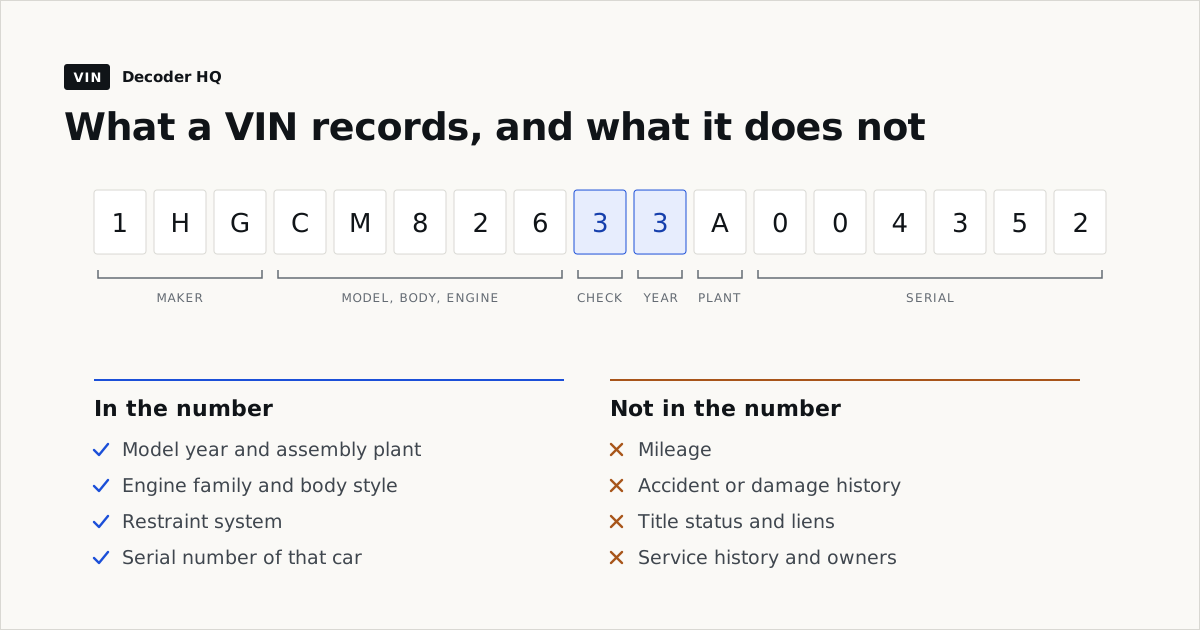
Here is what a VIN cannot tell you: a car's mileage, accident history, title brands, owners, liens or service record. What it does tell you is how the car was built: the maker, model details, engine family, model year, assembly plant and serial number. All of that is accurate and useful, and all of it describes one day, the day the car left the factory.
Everything after that day is somewhere else. That gap is where most of the confusion about VIN decoders comes from, and it is why people pay for reports that disappoint them. You can decode any VIN free to see the factory side for yourself.
What does each character in a VIN mean?
Every VIN has 17 characters, and each position has a job set by federal rules.
| Positions | What they record | Example use |
|---|---|---|
| 1 to 3 | Manufacturer and vehicle type | Who built it |
| 4 to 8 | Model, body, engine, restraint system and similar details | Which version it is |
| 9 | Check digit | Catches typos |
| 10 | Model year | 2026 is T, 2027 is V |
| 11 | Assembly plant | Where it was built |
| 12 to 17 | Serial number | Which car off the line |
The letters I, O and Q never appear anywhere in a VIN. They are left out because they look too much like 1 and 0. If you think you are reading an O, it is a zero. This is a common copying mistake, and it is why our decoder rejects those letters as you type.
The ninth character is a check digit, and you can test it yourself in seconds. If it fails, the VIN has been mistyped or is not genuine, and that is worth knowing before you drive anywhere to look at a car. If it passes, that only means the number is well formed, not that it belongs to this car. The math is public, so anyone making up a VIN can get it right, and about one random string in eleven passes by chance.
What does a VIN decode not show?
A decode tells you the car was built with a 3.5-liter V6. It cannot tell you the engine in it today is the third one. It tells you the car left a plant in Ohio as a front-wheel-drive sedan. It cannot tell you about the flood, the rebuild, the two owners who never changed the oil, or an odometer that was rolled back.
| Not in the VIN | Where that information lives |
|---|---|
| Mileage | Title transfers, inspections and service records. NMVTIS shows the latest reading reported to a state. |
| Accident or damage history | Insurance claims and repair records |
| Title brands such as salvage, flood or junk | State title records, collected in NMVTIS |
| Service history | The shops that did the work, and the owner's receipts |
| The owner | State DMV records, which federal law keeps private |
| Liens or loans | The lender and the state title record |
| Theft | Police records. NMVTIS carries some historical theft data. |
The owner row matters. Federal law limits what a state motor vehicle department can release about the people on its records. States may release owner details only for specific uses the law permits, so a consumer VIN site should not hand you a name or address. Be wary of one that offers to.
Why do free VIN decoders show so many blank fields?
This part surprises people. NHTSA's vPIC database, the federal source our decoder reads, tracks 145 vehicle variables. Manufacturers fill in only some of them. In sample decodes we ran in October 2026, cars from model years 2003 to 2017 came back with values in 30 to 34 fields.
Those blanks are not a free tier being held back. The manufacturer never submitted the data, so a decoder that reads vPIC cannot fill it in. When a site shows four fields and a padlock next to twenty more, ask what the locked fields actually contain before you pay.
vPIC is public and free, so any decoder can use it for factory specs. What a paid history report sells is the other data: title, odometer and claims records. That is a real product. Paying just to see the factory build is not.
Is a paid vehicle history report worth it?
Yes, when you are about to buy the car. The things that matter then are exactly what a VIN cannot tell you. Has it been declared a total loss? Has the odometer been tampered with? Is there a lien? Has it been stolen? A report that pulls state title records answers those, and next to the price of a car it is cheap.
It should not be sold to you as a way to find out what engine the car has. You get that free from the number itself.
How should I check a used car's VIN?
- Check that the VIN matches everywhere. The dash, the door jamb and the paperwork should all agree. If they do not, walk away.
- Run the check digit. It takes thirty seconds and catches most typos. A pass does not prove the number belongs to this car.
- Decode it and compare the factory build with the seller's ad. If they are advertising a trim the number does not support, ask why.
- Check for open recalls at nhtsa.gov/recalls. It is free, and an unrepaired safety recall is both a hazard and a bargaining point. Manufacturers generally have to fix recalls free, unless the car was first sold more than 15 years before the recall was issued.
- Then, if you are buying, pay for a history report to cover title, odometer and claims.
Steps one to four cost nothing. Many people skip them and go straight to step five, which is the wrong way around.
If the car is past saving, the VIN still helps. Yards ask for it when you sell a junk car, and the engine code it decodes to is what you quote when you call a salvage yard for parts.
So what is a VIN good for?
A VIN is an excellent birth certificate and a poor biography. Use it as the first check, not the only one. Treat the blanks as the maker's silence rather than a paywall, and spend money only on the records that actually sit behind a paywall: title, odometer and claims.
Sources
- 49 CFR 565.13: VIN general requirements (17 characters, allowed letters, check digit)law.cornell.edu
- 49 CFR 565.15: VIN content requirements (what each position means)law.cornell.edu
- NHTSA vPIC: Product Information Catalog and Vehicle Listingvpic.nhtsa.dot.gov
- NHTSA vPIC API: vehicle variable listvpic.nhtsa.dot.gov
- NMVTIS: information for consumers (title, odometer, brands, theft)vehiclehistory.bja.ojp.gov
- 18 U.S.C. 2721: Limits on releasing personal information from state motor vehicle recordslaw.cornell.edu
- 49 U.S.C. 30120: Recall remedies, including the 15-year limitlaw.cornell.edu
Last checked: