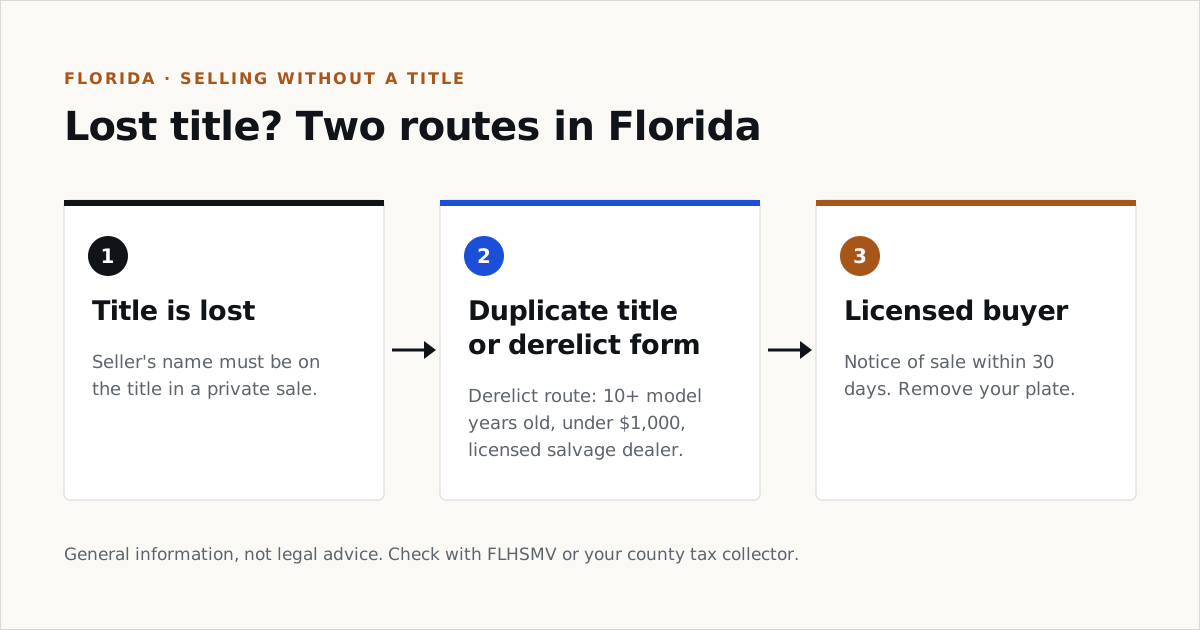
You can sell a car without a title in Florida only in narrow cases. For most sales, the usual route is to get a duplicate title first. The owner applies to the state, and the county tax collector can issue it. The exception is an old, low-value junk car. A car at least 10 model years old, worth under $1,000 and valued mainly for parts or scrap can go to a licensed salvage dealer on a derelict motor vehicle certificate application instead.
Everything below comes from the Florida Statutes. Where a form number or fee matters, we point you to your county tax collector rather than guess at it.
How do I get a duplicate title in Florida?
Florida Statutes §319.29 covers lost or destroyed titles. The owner, or the lienholder, applies to the Department of Highway Safety and Motor Vehicles on the form the department sets, with the fee. The application must be signed and sworn. The statute also says:
- the county tax collector can handle the application as the department's agent, and can hand you the duplicate at the office or mail it,
- the duplicate is marked "duplicate copy" across the face,
- a buyer can ask the seller to indemnify them against any claim made on the original title, and
- if you find the original later, you have to surrender it to the department.
If the title was mailed to you but never arrived, §319.29(3) lets you ask for a reissue within 180 days of the issue date, with no extra fee.
Start with your county tax collector's office. It can tell you the current form, the fee, and whether you can apply by mail.
What if the title is in someone else's name?
Florida is strict about this. In a private sale (one with no licensed dealer or insurer involved), §319.22(3) says no title will be accepted for transfer unless the seller's name is on the face of the title as owner. Section 319.22(5) adds that it's illegal to transfer a title when the buyer's name isn't on it.
So if you bought a car, took a signed title and never transferred it, you generally have to title it in your name before you can sell it. If the seller never gave you a title at all, start with that person. They're the one who can apply for a duplicate.
What if there's a lien on the car?
If a lender is still listed on the title, talk to it before you sell. When a car is dismantled, §319.30(2)(a) says the state cancels the title only with the consent of any lienholders on it, So expect to pay off or clear the lien first. The lienholder can also apply for a duplicate title under §319.29. For derelict sales (below), the statute has its own lien rules. If the lien is under 3 years old, the dealer holds the car for 10 days while the state notifies the lender, and a lender that objects can stop the lien from being removed.
Can I sell a junk car without a title in Florida?
Sometimes. Section 319.30 sets two tracks.
Most cars. When a car is sold or delivered to a salvage motor vehicle dealer, the dealer must report it to the federal NMVTIS system. The car must come with a valid title, salvage title or certificate of destruction in the seller's name or properly signed over. Knowingly selling or buying a car without one is a third-degree felony.
Derelict motor vehicles. A car valued under $1,000 that's at least 10 model years old (the model year counts as year one) can be a "derelict motor vehicle," if its main value is in parts or scrap. If no title is available, the seller (and the seller's transporter, if one is used) and the licensed salvage dealer fill in a derelict motor vehicle certificate application together at the time of sale. Then:
- the dealer needs a legible copy of your driver license or ID card,
- if you're not the owner of record, the dealer also takes your right thumbprint on the application,
- the dealer reports the car to NMVTIS and holds it for 3 full business days before crushing or dismantling it (10 days if there's a lien under 3 years old), and
- knowingly entering false information, skipping a required step or dismantling the car early is a third-degree felony.
The same process applies to registered secondary metals recyclers. The law defines "seller" as the owner of record, or a person who has possession of the car and attests they got it lawfully with all ownership rights. Towing companies, repair shops and landlords don't count unless they have a title, salvage title or certificate of destruction in their own name.
If you're going this route, find a licensed salvage dealer and ask whether it handles derelict applications. Our Florida junk car buyers page lists businesses that appear to buy cars, and the Florida salvage yard directory has more. We don't check licenses, so ask each one.
Which paperwork do I need for my situation?
| Situation | What you usually need | Where to get it |
|---|---|---|
| Title lost, car in your name | Duplicate title application, signed and sworn, plus fee | County tax collector (agent for FLHSMV) |
| Title mailed but never arrived | Reissue request within 180 days, no extra fee | County tax collector or FLHSMV |
| Car in a previous owner's name | Title the car in your name first | County tax collector |
| Junk car under $1,000 and 10+ model years old, no title | Derelict motor vehicle certificate application, completed with the dealer, plus your ID | The licensed salvage dealer or registered metals recycler |
| Private sale | Bill of sale, notice of sale within 30 days, plate removed | FLHSMV or county tax collector |
| Sale to a licensed dealer | Bill of sale and plate removed; a notice of sale isn't required by law but is still worth filing | FLHSMV or county tax collector |
What do I file after the sale?
Section 319.22(2)(b) says a seller who has made a bona fide sale and handed over the car "shall notify the department within 30 days." The notice needs the VIN and the buyer's full name and ID details, such as a driver license number. Filing it (or delivering the properly signed title to the department) is what limits your civil liability for how the buyer drives the car afterward. The 30-day duty doesn't apply to a sale to a licensed motor vehicle dealer, which includes a licensed salvage dealer, or to an insurer. Filing a notice anyway still limits your liability.
Keep a bill of sale, a photo of the signed title or derelict application, and a copy of the notice.
What do I do with the license plate?
Take it off. Under §320.0609, the plate and registration stay in the owner's name, not the car's. On a sale, "the owner shall remove the registration license plate" and either return it or transfer it to a replacement vehicle.
What should I avoid?
- Signing over a title that isn't in your name. In a private sale it won't be accepted for transfer anyway.
- Leaving the buyer's name blank on the title, which §319.22(5) makes illegal.
- Selling a car to anyone, licensed or not, who wants it with no title and no derelict application. The law reaches both the seller and the buyer.
- Taking a price over the phone as final. It's an estimate until the buyer sees the car and your documents.
For a ballpark first, our junk car value estimator shows an estimated scrap and parts value with the arithmetic. It's an estimate, not an offer, and no buyer is bound by it.
Comparing states? Our Texas guide and Arizona guide cover how they handle the same problem.
Sources
- Florida Statutes §319.29: Lost or destroyed certificates (2026)leg.state.fl.us
- Florida Statutes §319.22: Transfer of title (2026)leg.state.fl.us
- Florida Statutes §319.30: Definitions; dismantling, destruction, change of identity of motor vehicle, vessel, or mobile home; salvage (2026)leg.state.fl.us
- Florida Statutes §320.0609: Transfer and exchange of registration license plates; transfer fee (2026)leg.state.fl.us
Last checked: