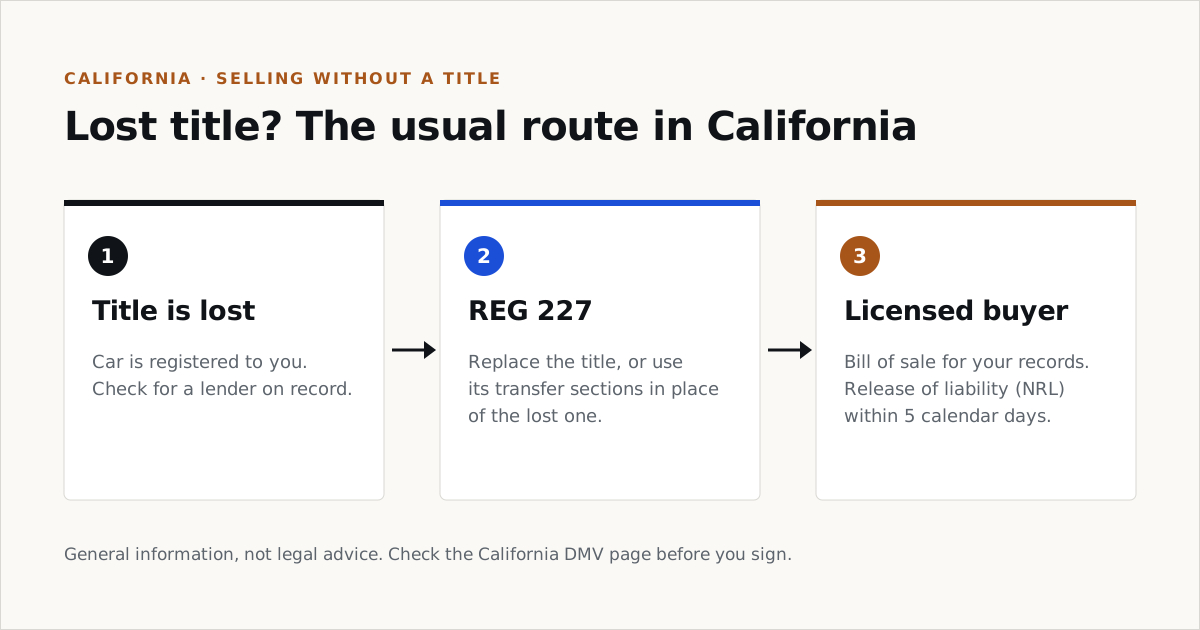
Yes, in most cases you can sell a car without a title in California, as long as the car is registered to you. You don't need the original paper title in your hand. The usual route is DMV form REG 227, the Application for Replacement or Transfer of Title. You can use it to order a replacement title, or you can fill in its transfer sections so it goes to the buyer in place of the missing one.
What you can't do is sell the car with nothing at all. A legitimate buyer, a licensed dismantler included, will want ownership paperwork from you, and you want paperwork for your own protection. Here's how it works.
What do I need to replace a lost title in California?
DMV says a title that is lost, stolen or damaged can be replaced with REG 227, submitted in person or by mail. There is also an online replacement title request on DMV's virtual office. You need your driver license or ID card, the last five digits of the VIN and the plate number.
A few details on the form itself (revision 9/2024) catch people out:
- A replacement title cancels the original. If the old one turns up later, it's no longer valid.
- If your address doesn't match DMV's records, you have to apply in person and bring proof of ownership, such as the registration card, and your license or ID.
- If the title was already replaced within the last 90 days, the form says a CHP vehicle verification is required.
- If a bank or finance company is listed as legal owner, its release on the form has to be notarized.
We couldn't confirm the current fee on an official page, so we've left it out. DMV's fee calculator and the form have it.
Can I sell the car without waiting for the new title?
Often, yes. REG 227 has two modes. "Replacement Title" (sections 1 to 3) just gets you a new title. "Transfer of Title with Replacement" lets the seller complete sections 1 to 4 and the new owner complete sections 6 and 7. So the form does the job of the signed-over title.
Section 4 is where you release your interest. Read the co-owner rule carefully. If two owners are joined by "AND" on DMV's records, both of you have to sign. The new owner then has 10 days from taking possession to complete the transfer, according to the form.
Whether a particular buyer will take a REG 227 instead of a title is up to them. Ask before you agree on anything.
What if the title is in someone else's name?
This is the hard case. REG 227 has to be signed by the registered owner of record, under penalty of perjury. If you bought the car years ago and never transferred it, the paperwork has to start with the person whose name DMV has on file. That might be the title they signed over to you. If that's gone, it means a REG 227 they sign.
Don't sign their name, and don't fill in a title or form you don't hold. If you can't reach the previous owner, talk to DMV about what it will accept before you try to sell. It depends on the facts, and we won't guess at it here.
What if there's still a loan on the car?
If a lender is listed as legal owner, it has to release its interest before a buyer can take clean ownership. DMV uses REG 166 (Lien Satisfied/Title Holder Release) for this, and a lienholder release on REG 227 must be notarized. The REG 227 form adds two limits. You can't use it to release an electronic lien. And for non-ELT lenders on vehicles two model years old or newer, the lender has to get the replacement title first and release interest on the actual title.
In plain terms: pay off the loan, get the release in writing, then sell.
Can I sell a junk car to a dismantler without a title?
California doesn't let a licensed dismantler junk a car on a handshake. Under Vehicle Code §11500, as DMV's dismantler handbook puts it, nobody may act as a dismantler without an established place of business and a DMV license or temporary permit. Before a dismantler takes a car apart, it reports the car to DMV and hands over evidence of ownership. It also turns in the license plates or a notice that it destroyed them.
DMV's handbook lists the documents it accepts from dismantlers as ownership evidence, and an application for duplicate title (REG 227) is one of them. So a lost title is a paperwork problem, not a dead end. A dismantler who says it needs nothing from you at all is telling you something about how it runs.
Our California junk car buyers page lists businesses that appear to buy cars, and you can also browse salvage yards in California. We don't check licenses, so ask each one whether it holds a DMV dismantler license and what documents it needs from you.
Which paperwork do I need for my situation?
| Situation | What you usually need | Where to get it |
|---|---|---|
| Title lost, car in your name, no loan | REG 227, or an online replacement title request | DMV forms page, virtual office or a field office |
| Selling before the new title arrives | REG 227, "Transfer of Title with Replacement" (seller sections 1 to 4) | REG 227 form |
| Car still in a previous owner's name | That owner's signature on the title or a REG 227 | The previous owner; ask DMV if you can't reach them |
| Loan paid off but lender still listed | REG 166 or the lender's notarized release | Your lender |
| Any sale | Bill of sale and an NRL filed within 5 days | DMV online NRL or REG 138 |
What should I file after the sale?
File the Notice of Transfer and Release of Liability. DMV says you're "required by law to notify DMV within 5 calendar days from the date you sell or transfer the title or interest in your vehicle" (Vehicle Code §5900). You can file online or use paper form REG 138. You'll need:
- the plate number, VIN, make and model year,
- the new owner's name and address,
- the odometer reading on the day of the sale,
- the date of sale, and
- your name and address.
DMV is clear that the NRL doesn't finish the transfer. The buyer still has to submit the transfer. But the NRL is your record that the car left your hands on that date, and that matters if a ticket or tow bill turns up later.
Also keep a bill of sale with the date, price, VIN, odometer reading and both names, plus a photo or copy of anything you signed. DMV has its own bill of sale form, REG 135, if you'd rather not write one up.
Do I take the plates off before selling?
Usually not. DMV says that "generally, license plates remain with the vehicle they were issued to." The exceptions are personalized, environmental, special recognition and special interest plates. You can move those to another vehicle if you ask and pay the fee. If you're selling to a dismantler, it deals with the plates as part of its DMV paperwork.
Take your registration card and any garage remote or toll transponder out of the car, though.
What should I avoid?
- Signing a title or form for a car you don't legally own.
- Selling to a buyer who won't put the deal on paper. If there's no bill of sale and no NRL, nothing shows the car stopped being yours.
- Skipping the NRL because "the buyer will handle it." The 5-day clock is yours.
- Taking a price over the phone as settled. Any figure before the buyer sees the car and your documents is an estimate.
If you want a rough idea of what a junk car is worth before you call around, our junk car value estimator shows an estimated scrap and parts value with the arithmetic. It is an estimate, not an offer, and no buyer is bound by it.
Moving between states? We also have guides for Texas and Arizona, where the rules are quite different.
Sources
- California DMV: Title transfers and changesdmv.ca.gov
- California DMV: Application for Replacement or Transfer of Title (REG 227, rev. 9/2024)dmv.ca.gov
- California DMV: Notice of Transfer and Release of Liability (NRL)dmv.ca.gov
- California DMV: Replacement title (online request)dmv.ca.gov
- California DMV: License platesdmv.ca.gov
- California DMV Dismantlers Handbook: License required (VC 11500)dmv.ca.gov
- California DMV Dismantlers Handbook: Documents required to obtain authority to dismantle a vehicledmv.ca.gov
- California DMV Dismantlers Handbook: Evidence of ownership documentsdmv.ca.gov
- California DMV Dismantlers Handbook: Application for duplicate titledmv.ca.gov
Last checked: