Before you drive out, ask a salvage yard five things: whether the part is still on the car, what it costs, what the entry fee is, when the gate stops letting people in, and what the return policy is. Also ask whether you pull the part yourself or the staff do it for you. One phone call with those questions saves most wasted trips.
A common complaint about buying used parts is the wasted trip: an hour each way to find the car already stripped, or the gate closed early, or the part sitting there with no socket set in your trunk. Find a yard near you in the salvage yard directory, then call with the list below.
Is it a self-service or a full-service yard?
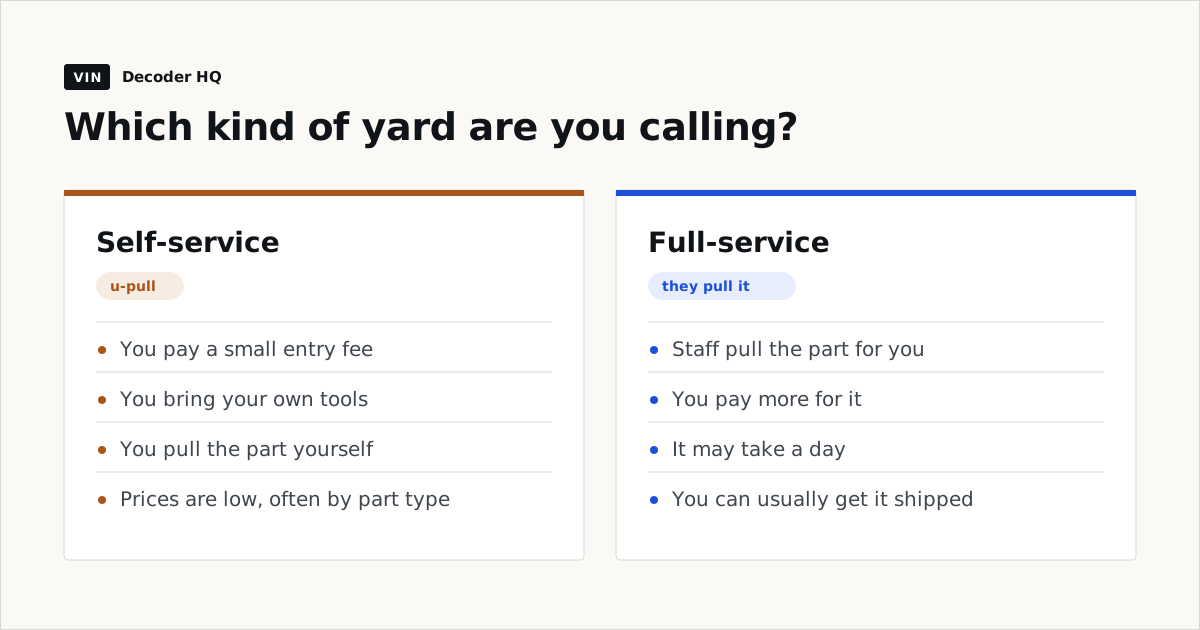
The two kinds of yard work very differently, and the names are no guide.
| Self-service | Full-service | |
|---|---|---|
| Who pulls the part | You | Yard staff |
| Tools | You bring your own | Not needed |
| Price | Low, often a flat price by part type | Higher |
| Entry fee | Usually a small fee per person | Usually none |
| Wait | As long as it takes you | Sometimes a day |
| Shipping | Rare | Often available |
A self-service yard is sometimes called a u-pull yard. You will do the work and you will get dirty. At a full-service yard you describe the part and someone pulls it from a car in the yard or from a shelf.
Plenty of businesses called "auto parts" are full dismantling yards, and plenty called "wrecking" sell over a counter. So ask directly: do I pull it myself, or do you? Our directory tags each yard by type where we know it, for example in Houston or Phoenix.
What should I ask a salvage yard on the phone?
"Is the part still on the car?" This is the one that saves the trip. Self-service inventory systems usually track which cars are in the yard, not which parts are still on them. A car that arrived three weeks ago has been picked over. If they can tell you when it came in, that tells you a lot.
"What do you charge for it, and is there a core charge?" Self-service yards usually work from a price list by part type, so an alternator costs the same whether it came off a Civic or a Corolla. Ask for the price of the part category, not for your exact car, and ask about a core charge on top.
"What is the entry fee, and does it come off the price?" It is usually a few dollars, and it is rarely refunded or deducted. Better to know before you reach the gate.
"When do you stop letting people in?" This one is rarely published anywhere. Many self-service yards stop admitting people some time before closing so everyone is out and through the register by close. A yard that closes at six may lock the gate well before that. If you are driving an hour, this answer decides whether you get the part or lose the evening.
"Do I bring my own tools, and is anything banned?" Self-service means your tools. A few yards rent basic kits. Nobody lends you a floor jack, and many yards ban torches, cutting tools and jacks for safety. Ask before you pack.
"What is the return policy?" Used parts are often sold as-is. Some yards offer a short exchange window, sometimes with a warranty for a few dollars more. Electrical parts are the ones to worry about. An alternator that is dead on arrival is a common and expensive annoyance, and being able to swap it matters more than saving five dollars.
"How do you take payment?" Some yards are still cash only, and some that take cards add a fee.
"Is there a minimum age, and do I need ID?" Many self-service yards set a minimum age, commonly 16 or 18, and ask for photo ID at the gate.
What information should I have ready before I call?
The call goes faster and the answer is more reliable if you can give them:
- Year, make, model and trim. Trim matters more than people think. It can change brake sizes, interior parts and sometimes the engine.
- Engine size and engine code. Two cars of the same model year often had two or three different engines, and parts do not always swap between them.
- The part number from your old part, if it has one. A matching part number settles any question about fit.
- Which side. Left and right are given from the driver's seat looking forward, not from standing in front of the car.
If you do not have the engine code or trim, decode your VIN first. The model and engine details are coded into characters four to eight, and the decode turns them into plain words in a few seconds. Some makers leave the trim or engine code blank, so check the part number too.
Why should I call more than one salvage yard?
Prices for the same part at two yards in the same city can differ by a factor of two, because one has six of that car in the yard and the other has none. Three calls take ten minutes. You also learn which yard answers its phone, which says a lot about how the visit will go. Start from your city's page, for example salvage yards in Los Angeles.
Could a recall cover the repair instead?
Check this before you buy anything. If the car has an open safety recall on the part you are replacing, it may not need a used part at all. The manufacturer generally has to fix a recalled defect free, unless the car was first sold more than 15 years before the recall was issued (for tires, 5 years). Check the VIN at nhtsa.gov/recalls before spending money on used parts for the same system. People do buy second-hand components to fix a fault the maker would have repaired for nothing.
And if the car itself is past fixing, is my junk car worth more in parts? explains how yards price a whole car, and the junk car value estimator gives you a starting number.
Sources
- 49 U.S.C. 30120: Recall remedies without charge, and the 15-year limitlaw.cornell.edu
- NHTSA vPIC: Product Information Catalog and Vehicle Listing (engine and trim data behind a VIN decode)vpic.nhtsa.dot.gov
- 49 CFR 565.15: VIN content requirements (where model and engine details sit in the VIN)law.cornell.edu
Last checked: